
Mortgage distress is pronounced in Victoria
Following the Reserve Bank of Australia’s interest rate hikes in 2022 and 2023, mortgage arrears across the country began to rise, with Victoria emerging as a key area of concern. While New South Wales and Queensland have shown resilience, Victoria’s arrears have shown a marked upward trend, highlighting regional disparities in household financial stress and borrower adaptability.
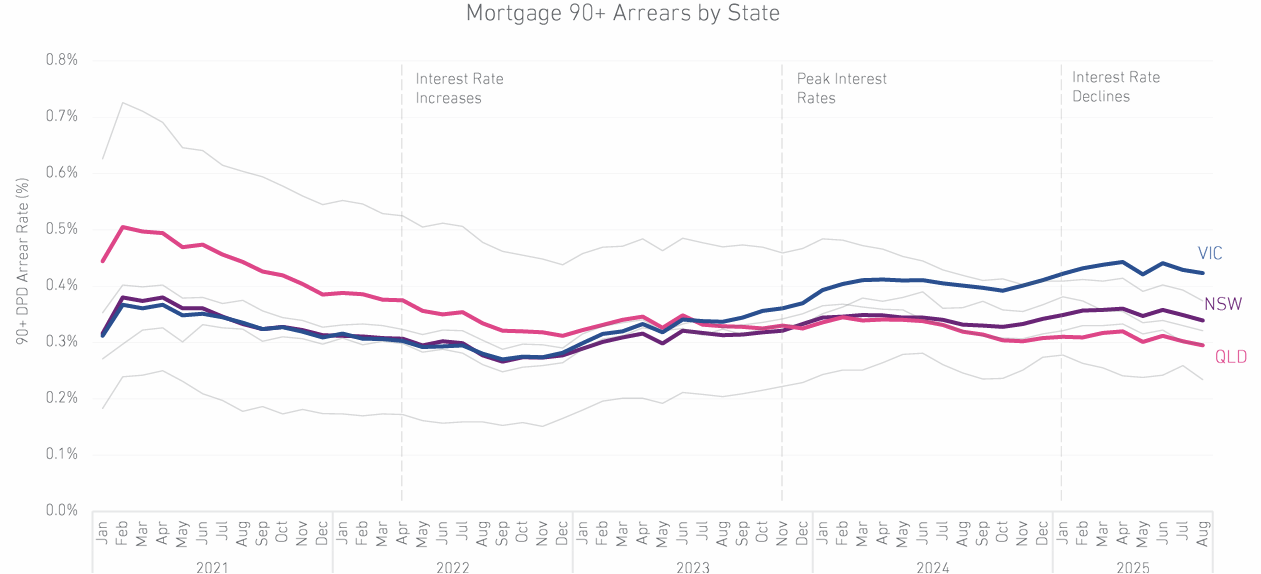
Australian mortgage arrears began to rise approximately six months following the increase in interest rates. Prior to 2023, Victoria, along with New South Wales (NSW), had one of the lowest mortgage arrears rates in the country. However, since 2023, Victoria’s arrears have risen more rapidly than those in other states. While NSW arrears have almost returned to pre-rate hike levels, Victoria’s arrears have surged by approximately 50%.
This suggests that additional economic and market forces, beyond interest rates, are impacting Victorian mortgage holders. In the following analysis, we examine loan vintages for the past five years and explore several key factors contributing to Victoria’s elevated arrears position.
Arrears surge across 2022-2024 vintages
A closer look at Victoria’s loan vintages (originations) reveals a clear shift in maturity dynamics. Since Q1 2022, nearly all quarterly vintages have been maturing at twice the rate observed than those prior to 2022. The persistently elevated arrears in the 2024 and 2025 vintages suggest that this accelerated trend is continuing, reinforcing concerns about sustained credit stress in the state.
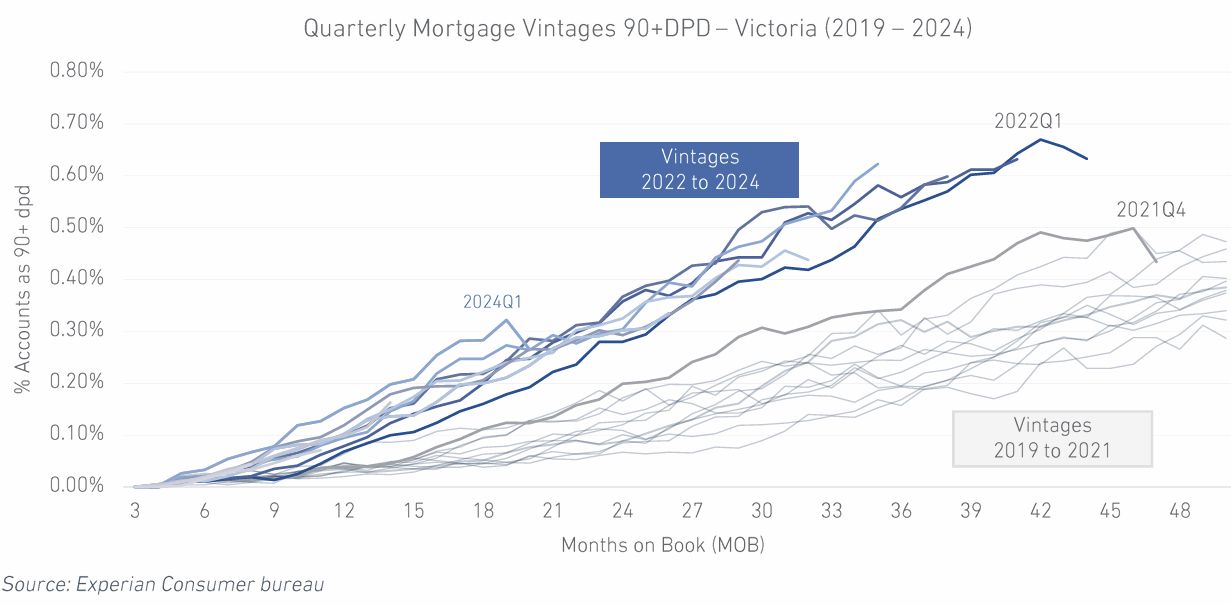
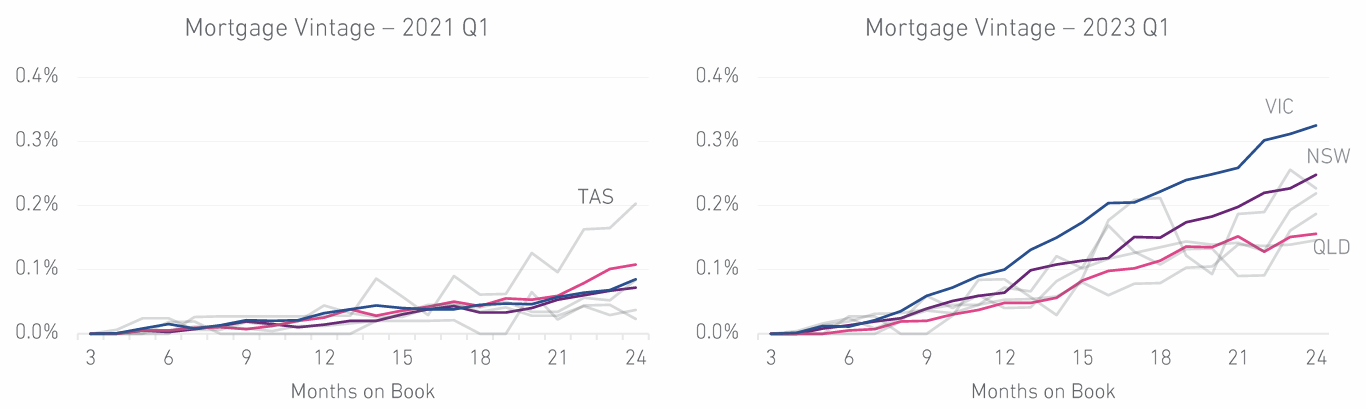
The divergence in arrears rates has largely been driven by the performance of recent loan vintages. Since Q1 2022, Victoria’s loan vintages have matured at a faster rate and recorded higher arrears each year compared to other states. This trend is illustrated in the following graphs, which compare vintages by state for Q1 2021 and Q1 2023.
In 2021 arrears rates were low nationwide and Victoria was in line with other states. Compared to 2023, however, while all states experienced an increase in late payments, Victoria’s arrears accelerated at a faster pace and reached higher levels.
Stress is broad-based across Victoria
The rise in mortgage arrears appears to be broad-based in Victoria. Both wider Melbourne and inner regional areas (areas such as Ballarat and Bendigo) have consistently recorded higher arrears rates in recent loan vintages compared to national averages since the start of 2022.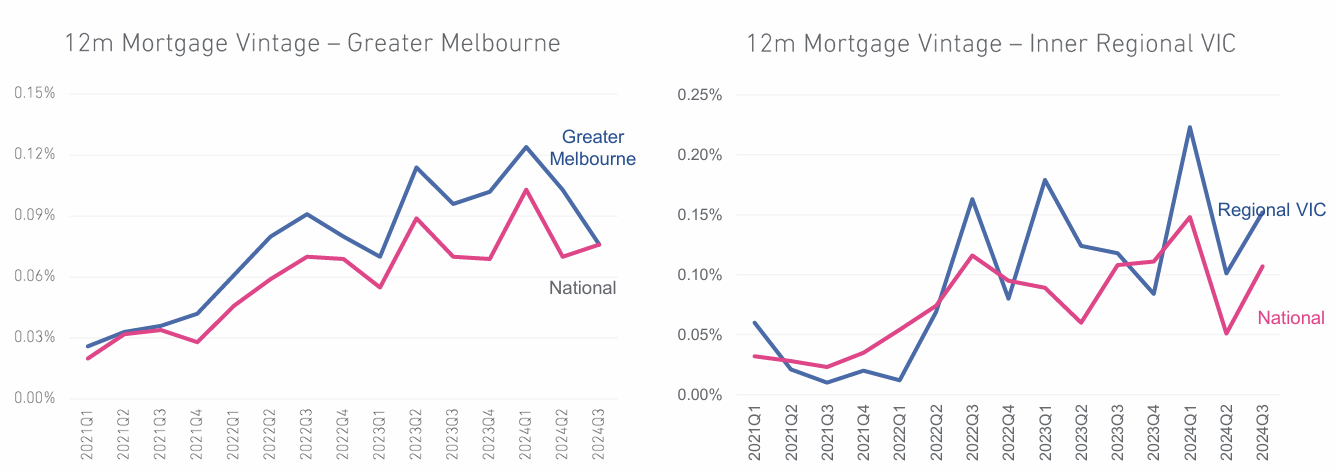
Key drivers behind Victoria’s elevated arrears
Two primary reasons that cause a borrower to fall into arrears are an unexpected loss of income or pressure on their budgets due to increased costs. Typically, borrowers that are more highly leveraged (with a high loan-to-value ratio) are at a higher risk of falling into arrears, as they are more prone to economic shocks such as job loss, high inflation, or large unexpected expenses.
There are several macroeconomic factors observed in Victoria that may help to explain the disparity in mortgage arrears for Victorians compared to other states.

Higher unemployment rates
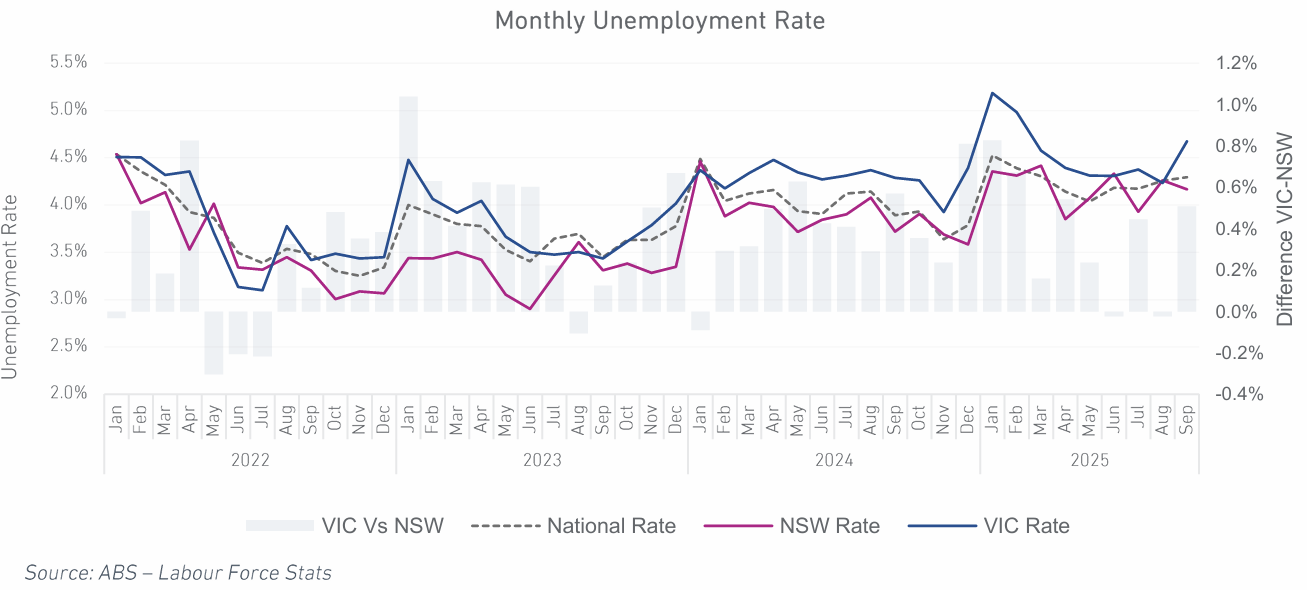
The impact of rising interest rates coincided with ongoing challenges in Victoria’s labour market recovery following the COVID-19 period. Since the rate hikes began in 2022, Victoria has consistently recorded one of the highest unemployment rates in the country.
Compared to NSW, Victoria’s unemployment rate has averaged 0.5 percentage points higher, highlighting its slower rebound and greater economic strain. Additionally, the number of
JobSeeker recipients in Victoria increased by 13% year-on-year on average each month in
2025, compared to the national average of 8.5%.
As job losses, reduced hours and consequently reduced income persists, more households fall behind on payments; a key driver of higher arrears compared to states with stronger labour markets.
Declining house prices
Declining housing prices have also played a role in rising mortgage arrears. Since emerging from the COVID-19 period, Melbourne property values experienced a modest decline in many suburbs, in contrast to the growth seen in Sydney and Brisbane in particularly.
This capital depreciation during a period of rising interest rates meant mortgage holders faced a dual challenge: higher repayment obligations and shrinking property equity. Falling house values reduce the ability to refinance or sell, and in severe cases can lead to negative equity, where the loan exceeds the property’s worth. Without this equity buffer, borrowers under financial stress in Victoria have fewer options to avoid arrears, making defaults more likely compared the other states where rising property prices provided a safety net.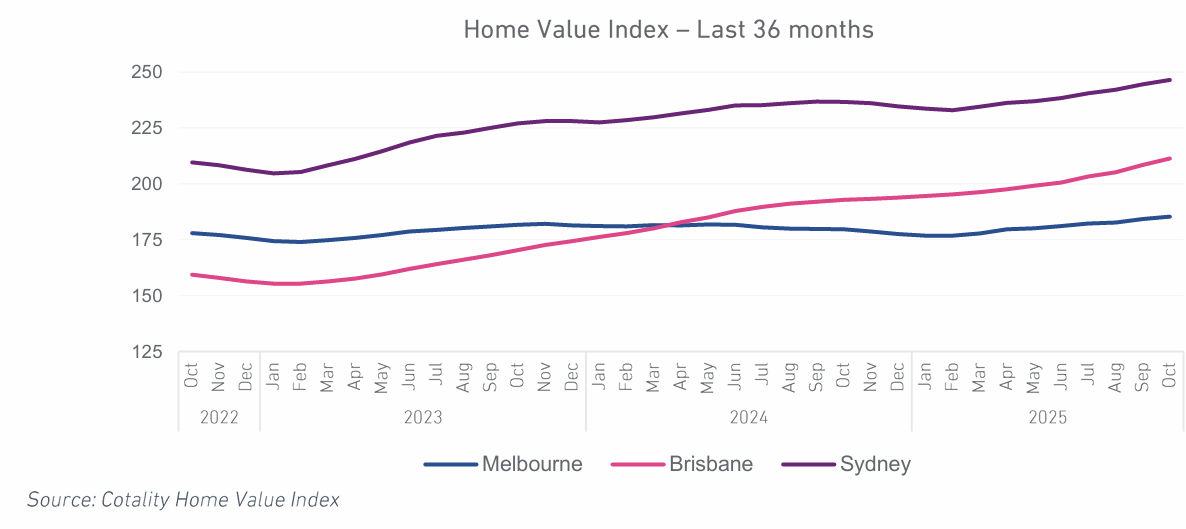
Tougher business conditions
Victoria is home to approximately 650,000 small businesses and with many of these businesses, the owner will also carry a mortgage. For these business owners, staying current on mortgage commitments relies heavily on the stability of their business cash flow. When revenue streams weaken or become unpredictable, which can be driven by macroeconomic conditions, the ability to meet these obligations deteriorates. Businesses that over-leverage by carrying both a business debt and a personal mortgage further amplify this vulnerability.
Compared to the rest of Australia, Victoria has had a more subdued economic environment marked by slower growth, weaker consumer spending, and higher operating costs. Higher payroll costs (due to a lower tax-free threshold) and land taxes, stringent regulatory requirements, and rising compliance costs compressed margins for many businesses. It is likely that these pressures will have translated into tighter cash flows, making timely mortgage repayments more difficult for owners.
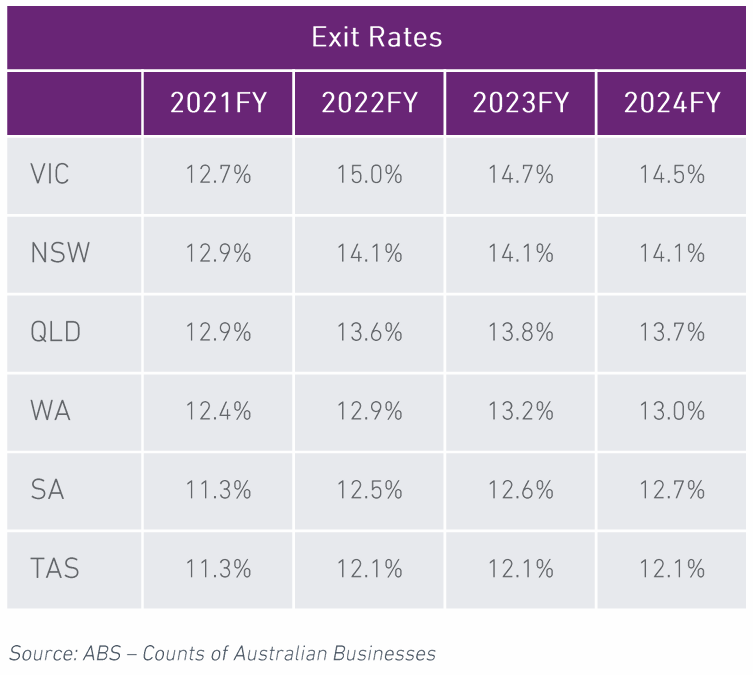
Each year since 2022 Victoria has had the highest exit rate of businesses nationally, signalling elevated distress in the state. When businesses shut down, owners often lose their primary income source, directly impacting their ability to service mortgages.
Victoria’s elevated mortgage stress reflects a complex mix of economic headwinds, business vulnerability, and household debt dynamics. Persistent cash flow pressures on small business owners, elevated unemployment, and a period of declining property prices amplified arrears risk across the state.
How can we help?
Market insights provide our clients with a deep understanding of their competitive landscape, customer behaviour and market dynamics. By leveraging internal data, industry benchmarks, and external market intelligence, these services can help uncover trends, identify growth opportunities, and inform strategic decision-making. Turn market intelligence into competitive advantage with data-driven insights that drive growth. Contact us to find out how.
Like what you’re reading? We release the Experian Business Pulse Monthly each month and features a Spotlight topic, much like this article. To get the latest reports directly to your inbox, be sure to subscribe.
Contact Us
Disclaimer: This report is provided by Experian Australia Pty Ltd general information and it is not (and does not contain any form of) professional, legal or financial advice. Experian and its related bodies corporate make no representations, warranties or guarantees that the information (including links and the views / opinions of authors and / or contributors) contained in this report are error free, accurate or complete. You are solely responsible and liable for any decision made (or not made) by you in connection with the information contained in this report. Experian (and its related bodies corporate) exclude, to the extent permitted by law, all liability for any and all loss, cost, expense, damage or claim incurred by a party as a result of or in connection with (whether directly or indirectly) this report or any reliance on the information in this report or links contained within. Nothing in this disclaimer excludes, restricts or modifies any rights or remedies that cannot be excluded, restricted or modified under applicable law. Experian and its related entities own, or are licensed to use, the intellectual property rights in this report and its contents. Except as permitted by law, the contents of this report must not be reproduced, modified, distributed or republished without Experian’s prior written consent.
Experian and the Experian marks used herein are service marks or registered trademarks of Experian or its related entities worldwide. Other product and company names mentioned herein are the property of their respective owners.