
Late Payment-Insolvency Connection
Monitoring commercial risk metrics
There is a strong relationship between late payments and business insolvencies. Evidence from the Experian Commercial Bureau establishes Trade Late Payments (TLPs) as an excellent leading indicator for business insolvency risk, across the Australia and New Zealand domains.
TLPs data features extensively in Experian’s commercial risk scores (the Failure Risk Score and Late Payment Risk Score) and are powerful risk segmentation and ranking variables for our clients’ scorecards, collections and portfolio risk management processes. It serves as a useful proxy for payment behaviour and credit quality deterioration.
Rising TLPs can potentially signal business stress (such as customer financial distress, credit policy deterioration, collection/cash efficiency problems), but also external factors (such as industry specific changes, economic trends, public policy).
Insolvencies
Company insolvency occurs when a business can no longer pay its bills as they become due. Insolvency is different from temporary cash flow problems – it represents a fundamental inability to maintain normal business operations and meet financial commitments. When a company becomes insolvent, it typically must enter formal processes such as administration or liquidation, which can result in business closure and job losses.
Trade Late Payment (TLPs)
Trade Late Payments refer to when businesses pay their suppliers, contractors, or service providers later than the agreed payment terms. For this report, the TLP metric we will focus on is the average number of days which companies are paying their bills/ invoices beyond agreed terms. For example, a TLP metric of 15 days, it means the business take 15 days on top of the original term to pay.
Insolvencies rise…along with Trade Late Payments
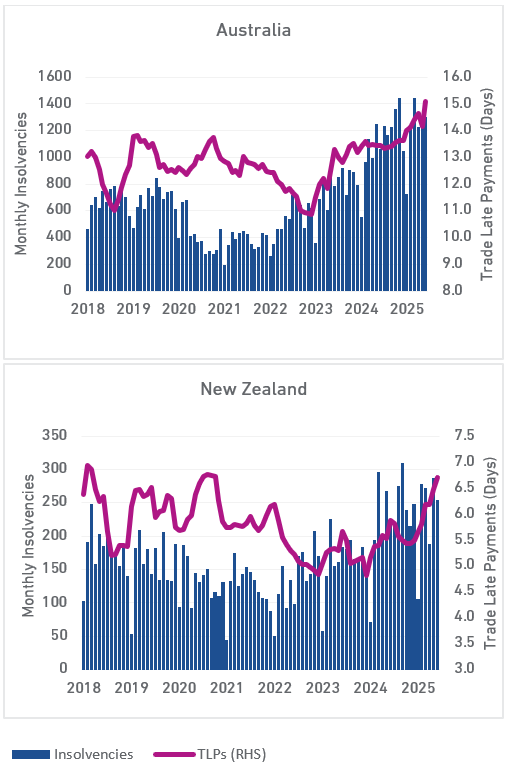
Insolvencies have been on the rise over the past few years in Australia, with the trend less pronounced but still increasing in New Zealand. Construction was overrepresented1, with insolvencies accounting for almost a quarter of total insolvencies – as well, accommodation and food services1 is another distress industry in Australia, while real estate1 and professional services1 having a fair share of insolvencies in New Zealand.
Late payment trends have risen too for Australia, following a decrease during the COVID periods (2021 to 2022). New Zealand levels are structurally lower than Australia but have recently started to spike.
The dance – TLPs leading insolvencies
Trends have changed over time and COVID policies have fundamentally altered some of the dynamics between businesses paying late and businesses going bust. Pre-2020, movements in TLPs would lead insolvencies by 6 months. The pandemic created unprecedented disruption to this relationship, artificially suppressing both insolvencies and TLPs. This created a “catch-up” effect, where we saw insolvencies materialise in 2024 as government support programs and relief measures ended. These were quite extensive, from JobKeeper to various business relief programs at the federal and state level.
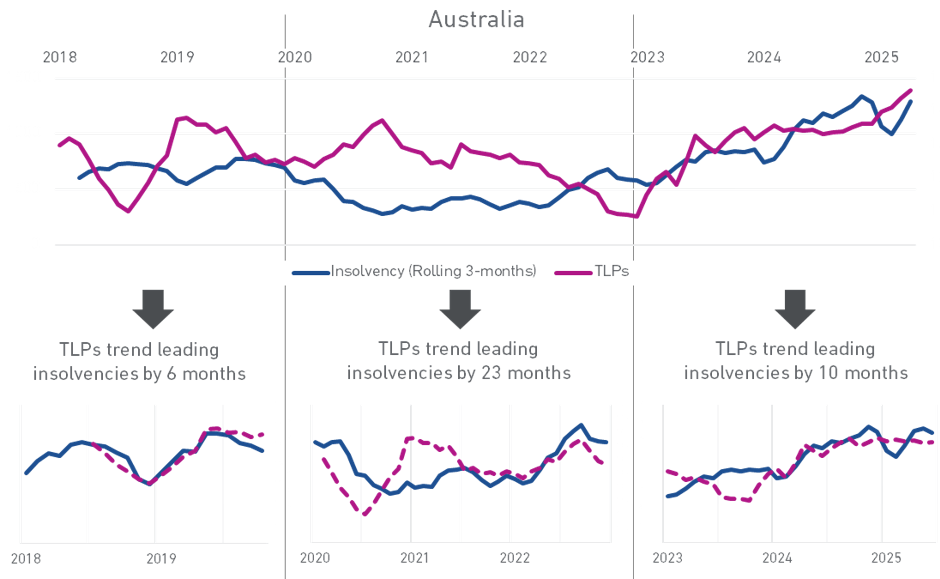
Post-COVID, insolvencies appear to be materialising slightly later as TLPs rise – with the lead lag relationship extending to 10 months on average. This is not a surprise given the multitude of challenges the economy has had to face over the past years. Inflation has caused cost-of-living pressures, creating a domino effect throughout the economy. Interest rate increases from 2022
to 2023 significantly amplified the impact of extended payment cycles, with higher borrowing
costs making it more expensive for businesses to finance working capital gaps created by late payments. Constrained consumer spending, along with higher costs of living and labour costs translates to financial pressures for businesses, ultimately delaying business-to-business payments (increasing TLPs).
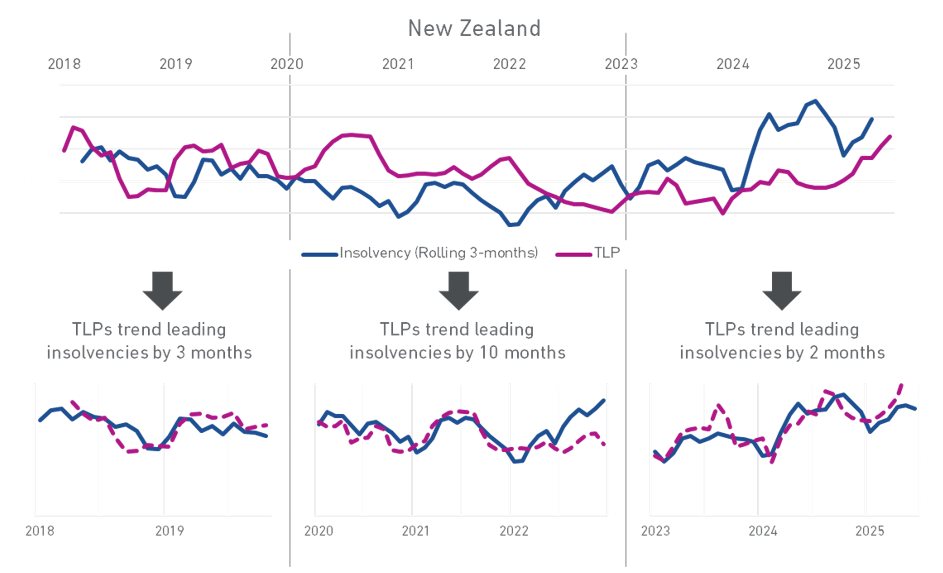
Similar trends have been observed in New Zealand, but the magnitude and timings are slightly different. Pre-2020, movements in TLPs would lead insolvency trends by 3 months, a much shorter lead time compared to Australia. The same extension of lead time between TLPs and insolvencies can be observed during the COVID period, demonstrating the insolvency paradox on how government intervention can temporarily decouple financial distress from business failure outcomes. Post-COVID, the dynamics have more-or-less returned to pre-COVID.
Mechanism linking late payments to insolvency
Correlation doesn’t imply causation but logically, an increase in TLPs increase insolvency risk through several interconnected mechanisms.
 |
Cash Flow Disruption: When customers delay payments, businesses struggle to meet operational expenses including wages, rent and supplier payments. This creates immediate working capital shortages that can push companies toward insolvency.
|
 |
Debt Spiral Effect: Companies experiencing payment delays often resort to costly financing options including overdrafts, business credit cards, or emergency loans. This increased debt burden weakens financial stability and erodes profit margins.
|
 |
Supply Chain Contagion: Late payments create a domino effect throughout supply chains. Academic research demonstrates that trade credit default provides an amplification mechanism for aggregate shocks, with default by some firms imposing losses on suppliers, leading to higher input costs and further bankruptcies.
|
Different sensitivities in different industries
Different industries exhibit varying sensitivity to TLP movements. Financial troubles and insolvencies may materialise very quickly once late payment stress increases in some industries (under 6 months), while insolvencies in some industries may remain stubbornly low for a long time (12 months and over – in some sub-industries up to 24 months).
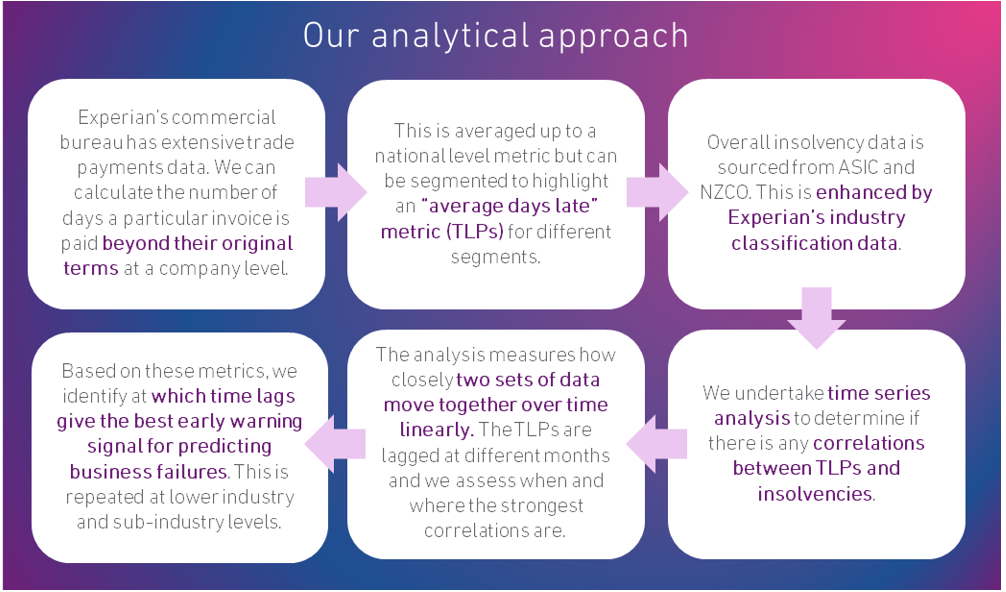
The results of our time series analysis is tabled below, highlighting not only differences between industries, but differences between Australian and New Zealand businesses.
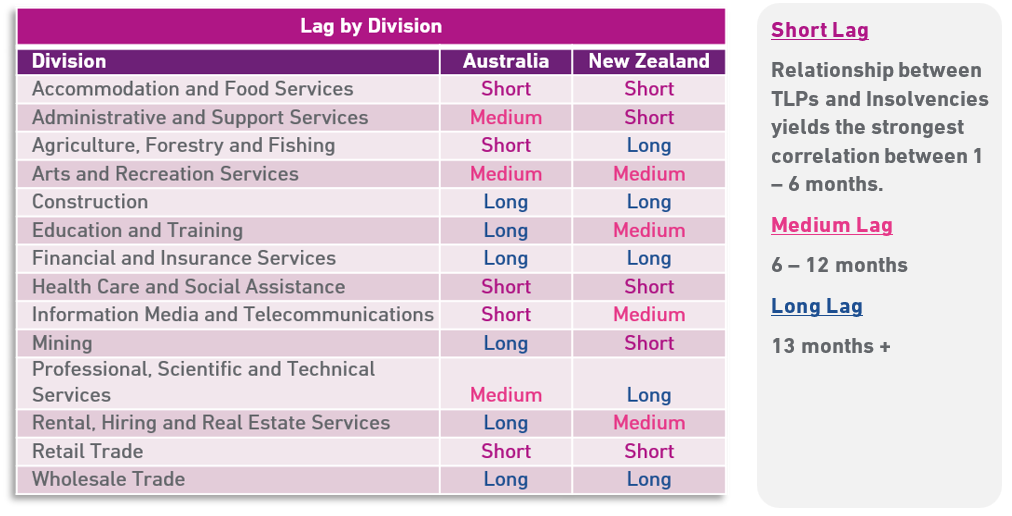
Short lags (1 – 6 months): Rapid impacts
Accommodation and food services
- Fixed cost structures: Rent, labour and utilities represent a significant portion of operating costs, creating immediate pressure when payments delays occur.
- Perishable inventory: Food wastage and capacity constraints mean delays cannot be easily recovered through future sales.
- Customer payment immediacy: Lower accounts receivable buffer – when customers don’t pay immediately, cash flow stops instantly, impacting business quickly.
- Regulatory compliance costs: Licensing, health and safety requirements create unavoidable fixed expenses.
Health care and social assistance
Despite the perception for stability in this sector, largely due to the essential demand of these services, both countries have demonstrated “short” lags.
- Staff retention: Shortages, burnouts, pay disputes and dissatisfaction with employers. Early financial distress can further exaggerate staff issues quickly.
- Insurance, financing: Insurance costs and equipment financing remain difficult for this sector.
Retail trade
- High inventory turnover: Depending on the sub-industry, average inventory turnover ratios can be relatively high and therefore require strong cash flow positions to maintain stock levels.
- Thin profit margins: Operating margins can be quite thin, providing minimal buffer for payment delays or demand disruptions.
- Seasonal concentration: 30-40% of annual sales often occur in specific months of the year, making payment timing management a critical aspect of retail trade business models.
Medium lags (6 – 12 months): Gradual impacts
Arts and recreation services
- Project-based revenue: Event planning and seasonal activities create lumpy cash flow patterns with natural buffers.
- Discretionary spending dependence: Revenue depends on consumer discretionary income, creating vulnerability to economic cycles.
- Asset flexibility: Businesses might be able to adjust capacity by cancelling events or reducing hours, providing operational flexibility and buffer against payment distress.
Long lags (13 months +): Extended impact
Wholesale trade
Despite the perception for stability in this sector, largely due to the essential demand of these services, both countries have demonstrated “short” lags.
- Extended payment terms: Longer payment terms create natural expectation and accommodation for delayed payments.
- Inventory buffers: Larger and longer lasting inventory holdings provide better operational continuity (compared to retail trade) during cash flow stress. It can also help with financing.
- Supply chain position: Wholesalers often have strong relationships with both suppliers and customers, enabling payment term negotiations.
Financial and insurance services
- Regulatory requirements: Mandated financial buffers provide more short-term protection against operational stress.
- Diversified revenue streams: Multiple product lines and customer segments reduce dependence on any single cash flow source. Some products would also be quite essential.
Construction
- Project payments and longer cycles: Construction operates on extended payment cycles tied to project milestones rather than immediate transactions. Both Australian and New Zealand construction companies typically receive payments through progress claims that are submitted monthly or at specific project stages – creating natural cash flow buffers against payment issues translating into insolvency risk.
- Continuing housing and construction specific support: programs to boost skilled worker training, state funds to support delivery of housing-enabling infrastructure, Residential Development Underwrite (RDU) program to name
a few. These ongoing, structural government involvement in the construction sector will continue to extend lag times between TLPs and insolvencies in
both countries.
Stay ahead of the insolvency curve
The data demonstrates a clear and significant link between Trade Late Payments and business insolvencies. Late payments serve as both an early warning indicator of financial distress and a direct contributing factor to business failure through cash flow disruption, increased debt burdens and supply chain contagion effects. While payment delays alone may not be the primary cause of insolvency, they represent a critical risk factor that can push financially vulnerable businesses over the edge into insolvency, particularly affecting small and medium enterprises that lack the financial reserves to weather extended payment delays.
How can we help?
Market insights provide our clients with a deep understanding of their competitive landscape, customer behaviour and market dynamics. By leveraging internal data, industry benchmarks, and external market intelligence, these services can help uncover trends, identify growth opportunities, and inform strategic decision-making. Turn market intelligence into competitive advantage with data-driven insights that drive growth. Contact us to find out how.
Like what you’re reading? We release the Experian Business Pulse Monthly each month and features a Spotlight topic, much like this article. To get the latest reports directly to your inbox, be sure to subscribe.
Contact Us
This report has been compiled by data sourced from Experian Australia Pty Ltd and illion, an Experian Company, as well as other public sources as referenced where applicable.
Disclaimer: This Report is provided by Experian Australia Pty Ltd, as general information and it is not (and does not contain any form of) professional, legal or financial advice. Experian and its related bodies corporate make no representations, warranties or guarantees that the information (including links and the views/opinions of authors and/or contributors) contained in this Report is error free, accurate or complete. You are solely responsible and liable for any decision made (or not made) by you in connection with the information contained in this Report. Experian and its related bodies corporate exclude all liability for any and all loss cost, expense, damage or claim incurred by a party as a result of or in connection with (whether directly or indirectly) this Report or any reliance on the information in this Report or links contained within. Experian owns (or has appropriate licences for) all intellectual property rights in the information and this Report must not be edited, copied, updated or republished (whether in whole or in part) in any way without Experian’s prior written consent.