
Buy Now Pay Later regulation – significant reform
June 10, 2025 marked an important day for BNPL regulatory reform. The new regulatory framework represents a fundamental shift in how BNPL providers operate, bringing them under the same consumer protection umbrella as traditional credit products (such as Credit Cards, Personal Loans) while recognising their unique characteristics such as low-cost credit alternatives. In time, this pivotal moment will have far-reaching implications for Australians, from lenders, credit bureaus, banks, financial institutions, fintechs, to the millions of consumers who use these services to purchase goods and services.
Key BNPL changes
- Hold an Australian Credit License
- Comply with the National Credit Act, National Credit Code, and responsible lending obligations
- Perform credit checks
- Providers must offer financial hardship assistance
- Caps on certain fees
- Comply with AFCA complaint process
Key changes – not an exhaustive list
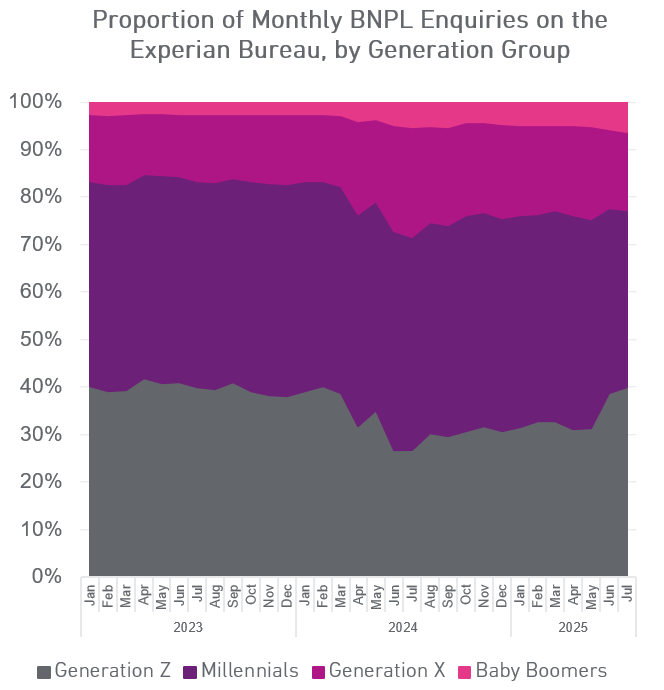
Demographic analysis – not just younger users
There has been a misconception that BNPL is a “younger person’s” product. Product design (mobile-first/mobile only) providers, a strong integration with e-commerce and social media, no credit history requirements, and the marketing message has always been centred around young consumers who have a greater distrust of banks and to whom zero-interest has a greater appeal.
Since 2024, there has been an increase in adoption of BNPL services from Gen X and Baby Boomers.
Latest figures show that Gen X and Baby Boomers account for 18% and 5% respectively of BNPL enquiries for 2025 YTD.
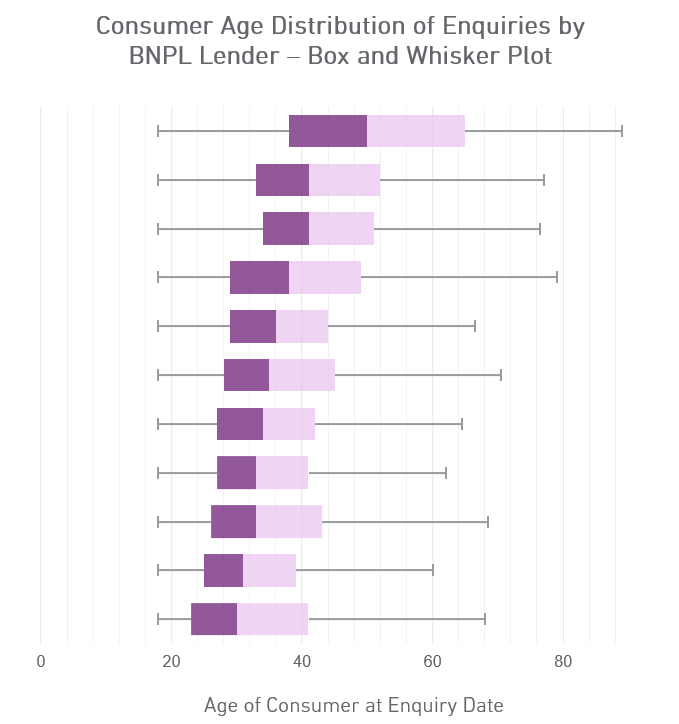
Since the regulation was brought in, there has been a slight uptick in Gen Z enquiries, but it would not be surprising for the increase in adoption by the broader population across all age groups to continue.
More regulatory oversight of BNPL will likely bring about a perception of increased credibility with the product – providing the legitimacy needed to overcome adoption barriers from older generations who would have more experience with financial crises.
The BNPL repayment structure also provides an attractive alternative to the traditional monthly repayment schedule of credit cards and personal loans. “Pay in 4” structures are now quite popular and available for many products and through a number of platforms.
The median age of BNPL enquiries is 32, but the distribution across BNPL providers is quite different, indicating that the product might appeal not only to different ages, but different segments, requiring different marketing and business strategies.
BNPL users – credit active and financially savvy
Access to unique BNPL enquiry data allows for a more comprehensive understanding of consumer credit risk. Analysis of early data available already challenges some of the perceptions of BNPL as a product and its users. For example, a lot of BNPL users (pre- and post-regulation) are established credit users. Prior to the regulation, 69% of BNPL enquiries had some other credit account already, suggesting that BNPL has functions as a complement to rather a substitute for traditional credit.
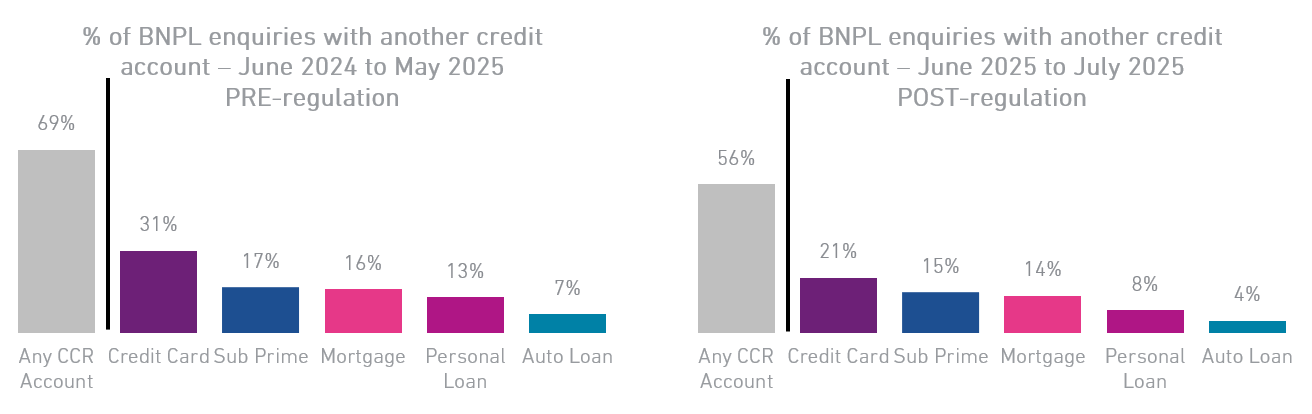
Nearly 1-in-3 already have a credit card, 1-in-7 can access unsecured credit, and 16% of BNPL enquiries can be linked to a mortgage – representing a sizable and sophisticated demographic (which would have needed to pass rigorous credit assessments).
It’s still early days, but the insights on the BNPL risk profiles is challenging some of the assumptions previously associated with BNPL as a product, and it serves as credit portfolio diversification rather than last-resort financing for most users.
New to bureau enquiries – more data for more accurate creditworthiness assessment
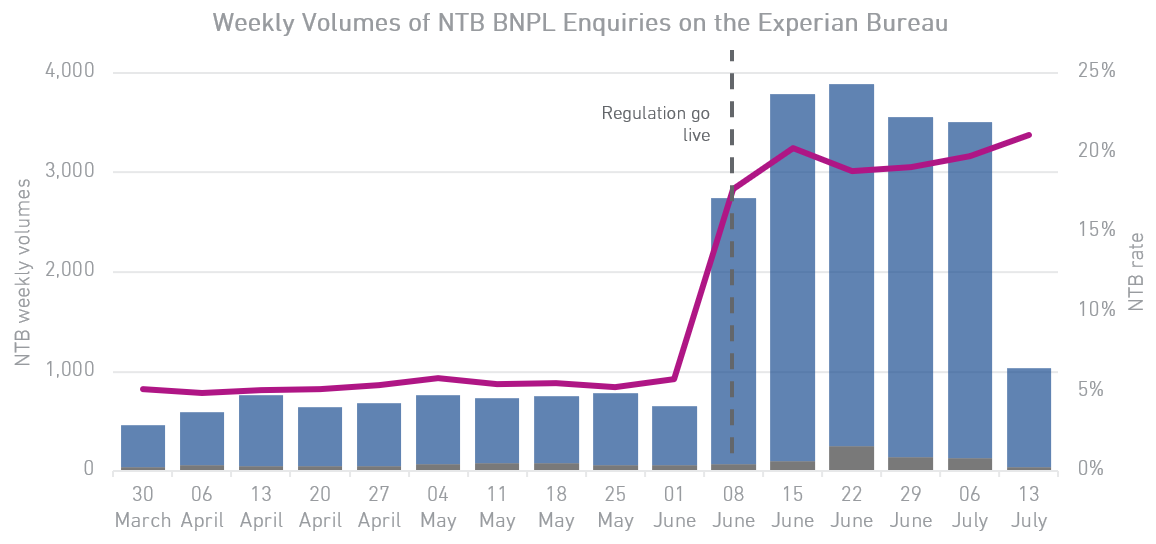
Following the June 2025 regulatory changes, Experian has seen a five-fold increase in weekly “New-to-Bureau” (NTB) BNPL enquiries, 94% of these consumers being unique to Experian Consumer Credit Bureau. More NTB enquiries bring about multitudes of benefits for the bureau, lenders and consumers. It facilitates more accurate credit modelling and credit scores by increasing the data points available for assessment, reduces the population with thin or no credit file and allows for the creation of a consumer’s credit history earlier in their credit journey. This earlier capture means a more comprehensive history can be built over time.
How can we help?
Market insights provide our clients with a deep understanding of their competitive landscape, customer behaviour and market dynamics. By leveraging internal data, industry benchmarks, and external market intelligence, these services can help uncover trends, identify growth opportunities, and inform strategic decision-making. Turn market intelligence into competitive advantage with data-driven insights that drive growth. Contact us to find out how.
Like what you’re reading? We release the Experian Business Pulse Monthly each month and features a Spotlight topic, much like this article. To get the latest reports directly to your inbox, be sure to subscribe.
Contact Us
This report has been compiled by data sourced from Experian Australia Pty Ltd and illion, an Experian Company, as well as other public sources as referenced where applicable.
Disclaimer: This Report is provided by Experian Australia Pty Ltd, as general information and it is not (and does not contain any form of) professional, legal or financial advice. Experian and its related bodies corporate make no representations, warranties or guarantees that the information (including links and the views/opinions of authors and/or contributors) contained in this Report is error free, accurate or complete. You are solely responsible and liable for any decision made (or not made) by you in connection with the information contained in this Report. Experian and its related bodies corporate exclude all liability for any and all loss cost, expense, damage or claim incurred by a party as a result of or in connection with (whether directly or indirectly) this Report or any reliance on the information in this Report or links contained within. Experian owns (or has appropriate licences for) all intellectual property rights in the information and this Report must not be edited, copied, updated or republished (whether in whole or in part) in any way without Experian’s prior written consent.