
What is Phoenix-ing?
Phoenix activity involves the deliberate and systematic liquidation of a corporate trading entity to avoid paying debts—including taxes, employee entitlements, and supplier obligations—while continuing business operations through a new company using the same or similar name, assets, staff, and premises. In New Zealand, this is regulated under sections 386A-386F of the Companies Act 1993, with penalties including up to 5 years imprisonment, $200,000 fines, and personal liability for phoenix company debts.
Farming the problem space
Using the Experian Commercial Bureau data, early-stage research has been undertaken on identifying the number of companies that potentially have been “phoenix-ed”.
Rationale for research
Validate our assumptions about phoenix-ing behaviour.
Surfaces risk patterns and trends to enhance understanding – improve detection methods and risk scores.
Lenders have expressed issues with phoenix-ing behaviours. Collaboration with our clients on improving risk management, fraud detection, issues relating to business integrity is vital.
Growing number of insolvencies in recent times means there is potential for more fraudulent behaviour.
Challenges
- Insolvency Classification – Refining how we distinguish genuine vs suspicious business failures
- Director Data Quality – Improving linkage and consistency across entities
- Corporate Complexity – Navigating layered structures to uncover hidden patterns
- Reactive Detection – Insights often surface retrospectively – highlighting potential for earlier signals
- Subtle Phoenix Patterns – Some phoenix-ing behaviours are intentionally disguised or complex, requiring deeper analysis to uncover
Methodology
- Identified NZ companies that failed between 2020 – 2023 using Experian commercial data as the foundation for analysis
- Differentiated genuine company closures from those with irregular deregistration patterns using Experian commercial data directly sourced from the NZ Companies Register
- Identified directors associated with those failed companies to begin mapping potential links across entities
- For each failed company, identified all associated directors and captured any new companies they registered within one year of the failure – regardless of whether those new entities were connected to the original company
- Flagged potential phoenix entities by examining whether newly registered companies linked to directors of failed firms shared notable characteristics suggesting continuity or deliberate replication through entity resemblance
- Validated flagged entities against internal logic and known phoenix cases sourced from public records to refine detection criteria and strengthen the reliability of the framework
Potential phoenix criteria
To detect potential phoenix-ing activity, we observed the directors of failed companies over the past four years and focused on these ‘similarity’ factors when another company is registered.
Company Name – Evaluate the similarity between the names of the failed and newly registered companies.
Failure Days The interval between the failure or deregistration of a company and the registration of a new entity under the same directorship. A shorter interval may suggest intentional continuity or evasion of financial obligations.
Industry Classification – Used to assess whether the new entity operates within the same industry (or similar) as its predecessor.
Residential Address – Determine if the new company’s address matches the residential address of the director.
Company Address – Comparison of addresses between the failed company and the newly registered entity under the same directorship.
Initial results on potential phoenix-ed businesses
In 2023, on average potentially 28 companies per month appear to be ‘phoenix-ed’ based on the pre-defined criteria.
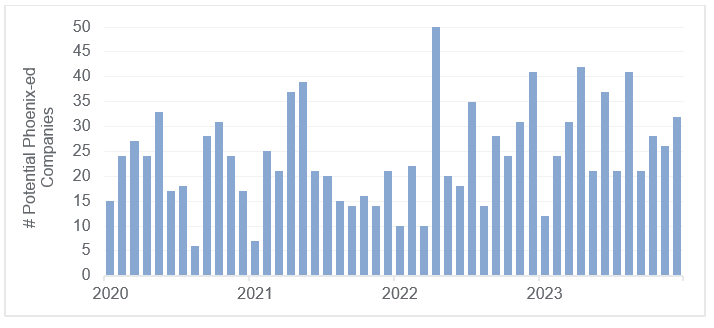
On average, 17% of failed companies and their directors are associated with potential phoenix-ing activity.
Highest % By Industry
30% Finance, Insurance & Real Estate
18% Manufacturing
18% Wholesale Trade
14% Construction
14% Agriculture, Forestry & Fishing
13% Retail Trade
E.g. The directors of the failed manufacturing companies – 18% of these directors are suspected of exhibiting potential phoenix-ing behaviours
By Business Age
Directors of failed “younger companies” (0-2 years) show higher potential phoenix-ing behaviours – 28%
While the construction sector makes up for one-third of insolvencies over the past two years, the instance of phoenix-ing activity (%) does not seem to be more prevalent in the sector.
Similar results have been observed in Australian businesses.
How can we help?
Market insights provide our clients with a deep understanding of their competitive landscape, customer behaviour and market dynamics. By leveraging internal data, industry benchmarks, and external market intelligence, these services can help uncover trends, identify growth opportunities, and inform strategic decision-making. Turn market intelligence into competitive advantage with data-driven insights that drive growth. Contact us to find out how.
Like what you’re reading? We release the Experian Business Pulse Monthly each month and features a Spotlight topic, much like this article. To get the latest reports directly to your inbox, be sure to subscribe.
Contact Us
This report has been compiled by data sourced from Experian Australia Pty Ltd and illion, an Experian Company, as well as other public sources as referenced where applicable.
Disclaimer: This Report is provided by Experian Australia Pty Ltd, as general information and it is not (and does not contain any form of) professional, legal or financial advice. Experian and its related bodies corporate make no representations, warranties or guarantees that the information (including links and the views/opinions of authors and/or contributors) contained in this Report is error free, accurate or complete. You are solely responsible and liable for any decision made (or not made) by you in connection with the information contained in this Report. Experian and its related bodies corporate exclude all liability for any and all loss cost, expense, damage or claim incurred by a party as a result of or in connection with (whether directly or indirectly) this Report or any reliance on the information in this Report or links contained within. Experian owns (or has appropriate licences for) all intellectual property rights in the information and this Report must not be edited, copied, updated or republished (whether in whole or in part) in any way without Experian’s prior written consent.