
Evaluating exposure risk across connected entities
Around 17% of active businesses in Australia are connected to another entity through legal ownership or governance structures. This increases to about 30% if cross-directorship links are included, however, for the purpose of this Spotlight we only considered legal company-to-company connections (refer to the right).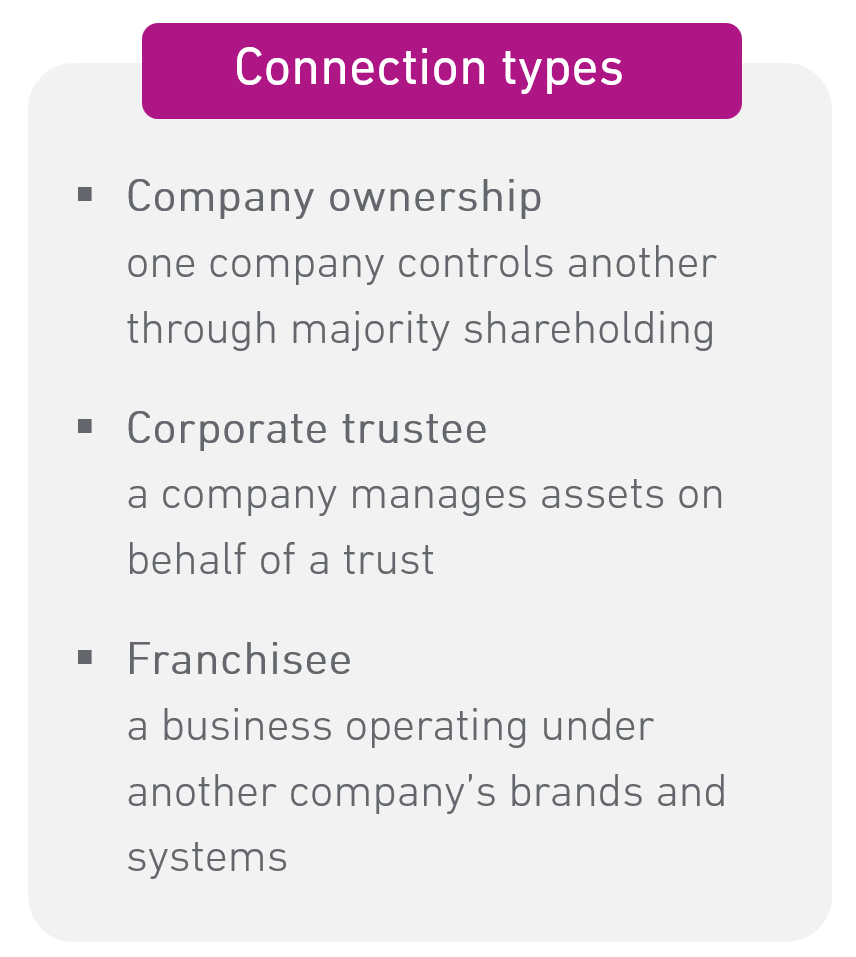
These connections, whether through parent or subsidiary relationships or cross-entity operational ties, can strongly influence a company’s financial stability. Yet, traditional credit assessments tend to focus solely on the individual customer, overlooking risks outside the immediate account view. For credit managers, this creates a blind spot.
A customer may present as low risk on its own but be closely tied to a parent or related entity that could be experiencing financial distress, be involved in adverse court actions or show signs of deteriorating trade payment behaviour. Without visibility of these relationships, credit decisions may expose the company to greater risk.
When we look beyond individual customers and include their corporate families and other connections, we find that a meaningful share of exposure is connected to distress and adverse events.
The goal is to equip credit managers with a fuller, more interconnected understanding of their portfolio, enabling more informed decisions, earlier identification of emerging issues and stronger overall risk management.
Why link distance matters
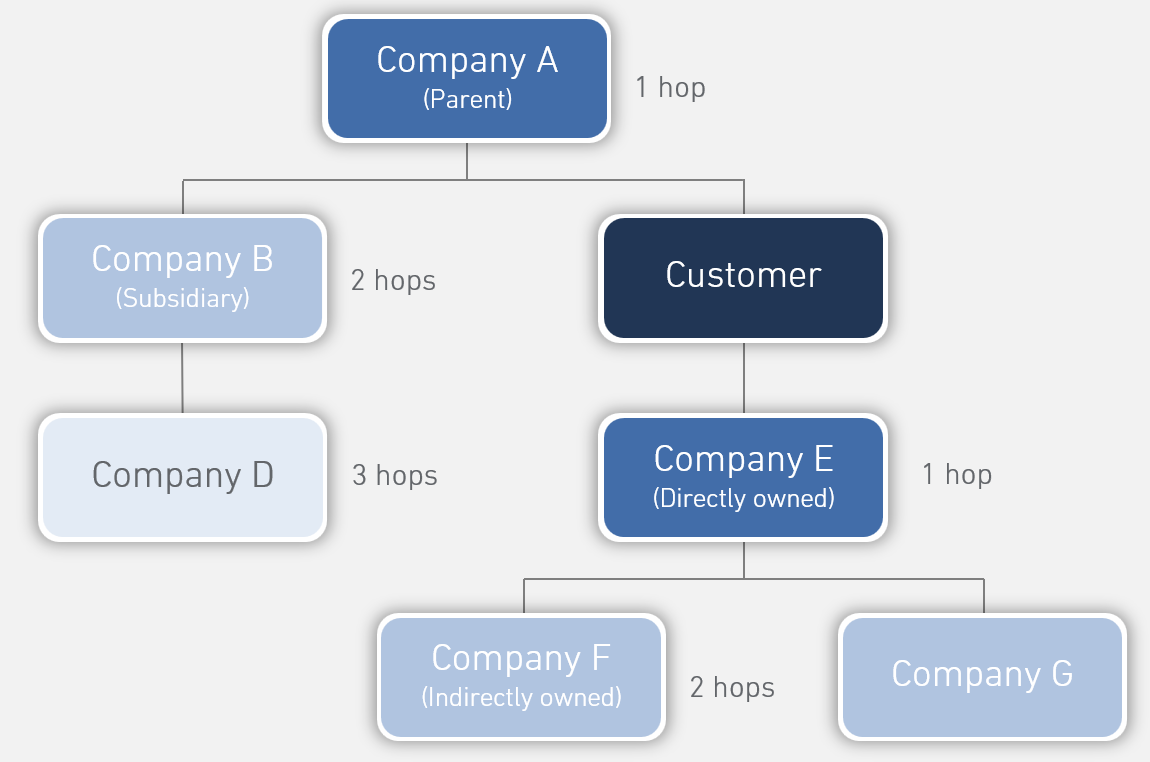 Not all connections carry the same level of risk. When an adverse event occurs at a company, such as a failure or a court action, that is directly connected to your customer (for example, its parent or a directly owned subsidiary), the likelihood of impact is much higher. These close connections often share funding, governance, and operational dependencies, which can quickly affect your customer’s financial stability.
In contrast, issues that present two or more hops (steps) awayin the corporate hierarchy (e.g., a sister company under the same parent or a subsidiary of a subsidiary) still matter but generally pose a lower immediate risk.
Understanding the distance of these adverse events is important for credit managers to prioritise reviews and apply appropriate risk adjustments.
A real-world example¹: Identifying hidden risk
In the following section we look at a real example of a company with over 10,000 business customers and $48 million in exposure. We identify hidden risks across connections that the company is exposed to that they would not be aware of when undertaking traditional account-level views.
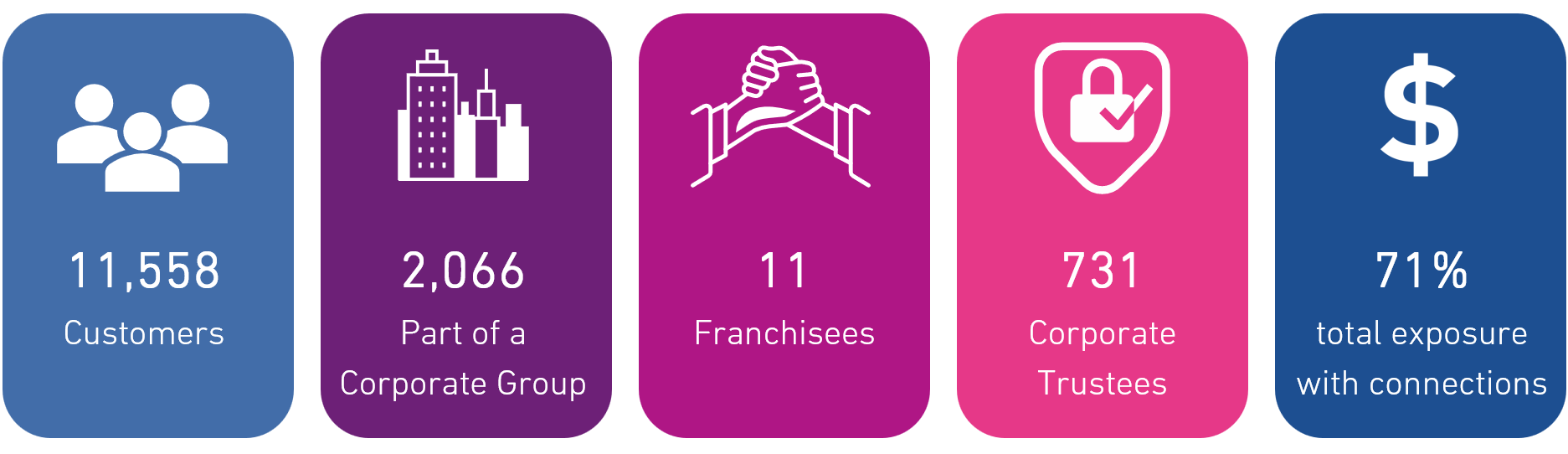
The figures below show that while 24% of their customers have connections to another entity,
these relationships represents over two-thirds (71%) of total exposure. This shows how connected entities, though fewer in number, contribute disproportionately to the company’s risk profile.
Company highlights
A real-world example¹ – Presence of adverse
At the entity level, only 3.3% of the company’s customers appears connected to adversewhen considering court actions, defaults and insolvencies. Once we include corporate families and trustee links, that rises to 5.2%. For this company, those additional 215 customers represent $7 million in total exposure – 14.3% of their total book.
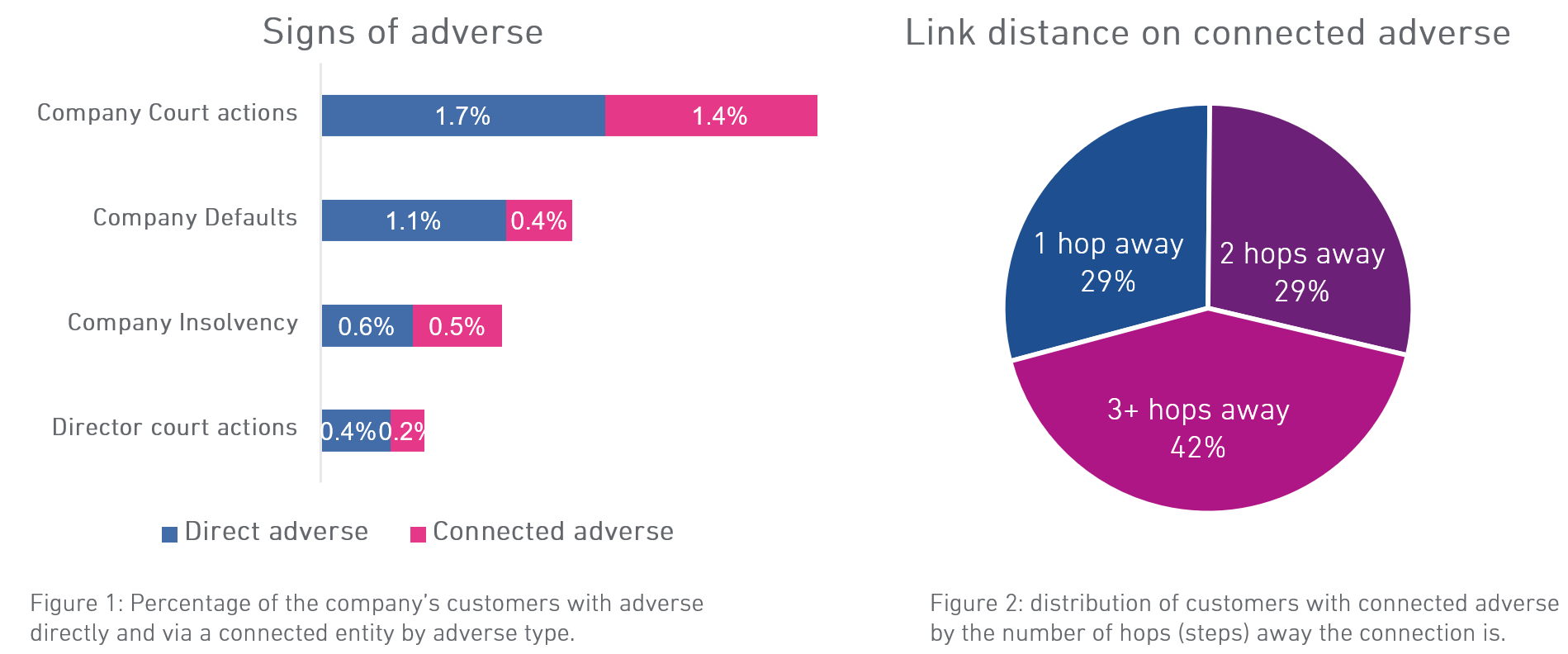
$7 million (14.3%) of total exposure with entities which have connected adverse that isn’t visible when looking at just individual customers.
Our analysis shows that there are 12 customers that have no direct adverse events themselves but are only 1 hop away, through an immediate parent, subsidiary or corporate trustee, from an entity that is in financial distress (insolvency).
Example¹– Connected failures could lead to defaults 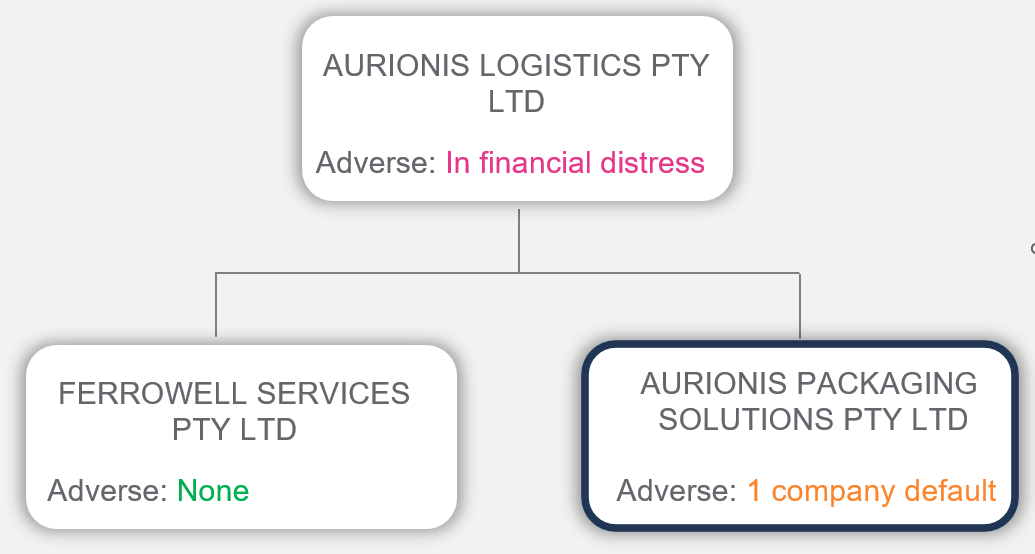
Here we see one of the company’s customers Aurionis Packaging Solutions Pty Ltd is part of a small company structure, and its parent company is in financial distress.
This represents a hidden risk as the subsidiary may suffer through funding cuts or operational disruption, possibly leading to the corresponding company default, with a risk of further defaults or even failure.
A real-world example¹ – Aggregated group exposure
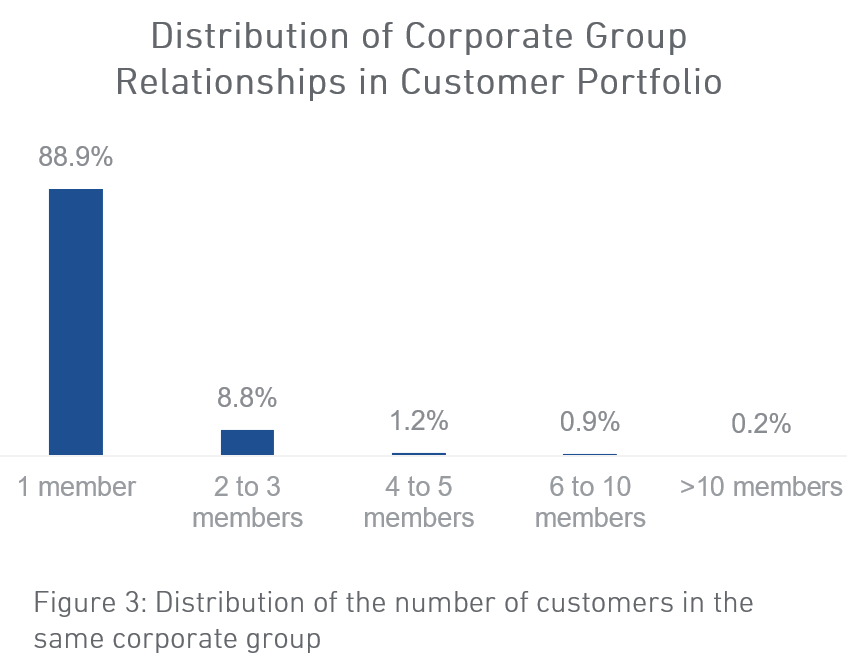
For the 2,066 customers that belong to a corporate group, our analysis shows that in 11% of cases (Figure 3) the company is doing business with more than one entity within the same group. If these relationships are not identified, there is hidden risk as exposure is fragmented across subsidiaries.
This is particularly relevant in industries such as banking, where regulatory frameworks require institutions to understand their Total Customer Exposure (TCE) and assess whether combined exposures exceed prescribed thresholds.
Figure 4 illustrates this by comparing individual customer exposure with their aggregated TCE. Many organisations apply enhanced risk processes once TCE surpasses certain thresholds. In this example, incorporating subsidiary relationships results in an additional 52 customers exceeding $50k exposure – customers who would otherwise remain below it when assessed in isolation.
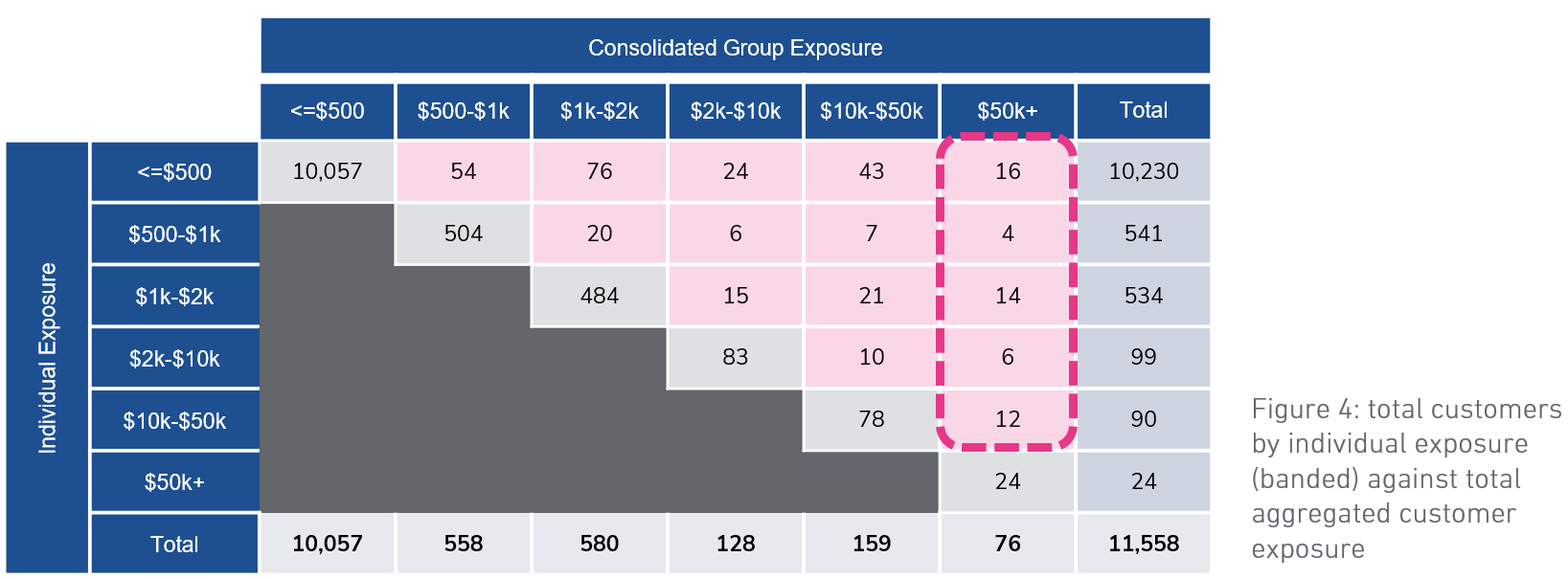
To manage their risk exposure, credit managers should incorporate these insights into their routine assessments. This includes introducing group‑level exposure limits to address concentration risk across related entities, embedding hierarchy and director‑linkage checks into onboarding and implement ongoing monitoring, with enhanced due diligence for customers connected to financial distressed or adverse‑event entities.
¹All data used in the real-world examples have been anonymised.
How can we help?
Market insights provide our clients with a deep understanding of their competitive landscape, customer behaviour and market dynamics. By leveraging internal data, industry benchmarks, and external market intelligence, these services can help uncover trends, identify growth opportunities, and inform strategic decision-making. Turn market intelligence into competitive advantage with data-driven insights that drive growth. Contact us to find out how.
Like what you’re reading? We release the Experian Business Pulse Monthly each month and features a Spotlight topic, much like this article. To get the latest reports directly to your inbox, be sure to subscribe.
Contact Us
Disclaimer: This report is provided by Experian Australia Pty Ltd general information and it is not (and does not contain any form of) professional, legal or financial advice. Experian and its related bodies corporate make no representations, warranties or guarantees that the information (including links and the views / opinions of authors and / or contributors) contained in this report are error free, accurate or complete. You are solely responsible and liable for any decision made (or not made) by you in connection with the information contained in this report. Experian (and its related bodies corporate) exclude, to the extent permitted by law, all liability for any and all loss, cost, expense, damage or claim incurred by a party as a result of or in connection with (whether directly or indirectly) this report or any reliance on the information in this report or links contained within. Nothing in this disclaimer excludes, restricts or modifies any rights or remedies that cannot be excluded, restricted or modified under applicable law. Experian and its related entities own, or are licensed to use, the intellectual property rights in this report and its contents. Except as permitted by law, the contents of this report must not be reproduced, modified, distributed or republished without Experian’s prior written consent.
Experian and the Experian marks used herein are service marks or registered trademarks of Experian or its related entities worldwide. Other product and company names mentioned herein are the property of their respective owners.