
Gen Z is emerging as an influential consumer group, with growing cultural and financial impact on what it means to be a modern Australian consumer. They are discussed widely yet often misunderstood.
Drawing on Experian’s demographic insights, Mosaic segmentation and spend analytics, this article provides insight into the behaviours and motivations of Gen Z. The analysis suggests a more diverse and complex generation than stereotypes suggest.
Who exactly is Gen Z?
Australia’s Gen Z population is defined here as people born between 1996 and 2005, which means they are currently 20 to 29 years old.
They are entering important life stages: early careers, shifting living situations, household formation and soon parenthood. According to ABS data, they will reach the median parenting age of 31 in 2027.¹
Experian’s insights highlight several emerging patterns:
- Many are moving into outer metropolitan areas in search of affordability and space.
- More are living with parents, reflecting cost pressures and cultural dynamics.
- Household formation varies. Some are share-house members, some are couples and others are already starting young families.
These shifts show a generation that is geographically fluid and financially diverse.
A generation defined by nuance, not stereotypes
Gen Z grew up with always-on technology, social platforms and global connectedness. They also experienced economic uncertainty, cost-of-living pressures and rapid societal change. Despite these shared influences, their lived experiences differ significantly.
Mosaic segmentation highlights several distinct Gen Z profiles
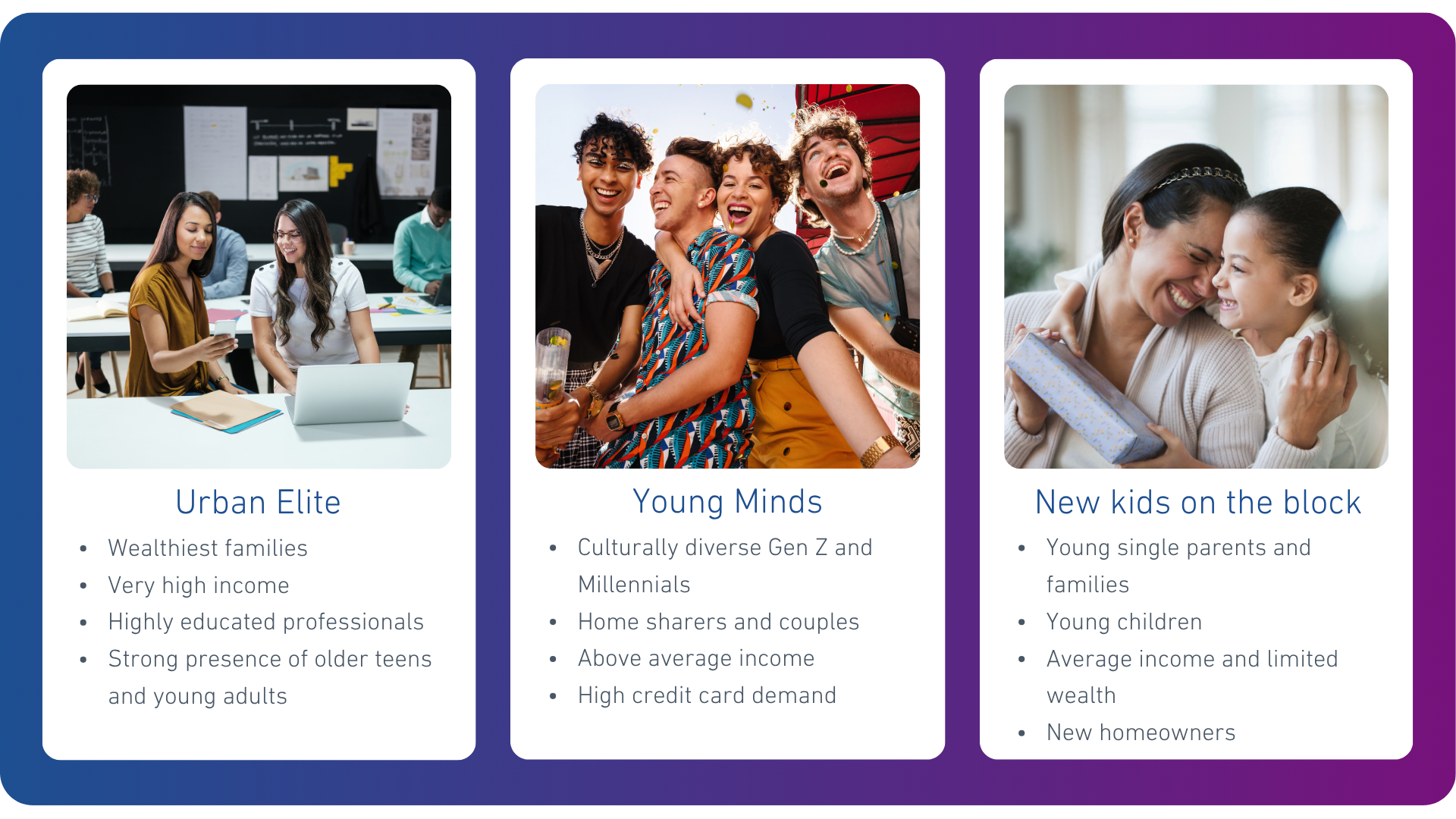
This diversity means that treating Gen Z as a single audience could lead to missed opportunities.
What Gen Z cares about
Across Mosaic types, several behavioural themes appear consistently in how Gen Z spend their time and money.
1. Entertainment and socialising: digital first, but still social
Experian’s spend insights indicate that Gen Z engage with entertainment differently depending on their financial and lifestyle realities.
- Urban Elite are estimated to be 1.4 times more likely to spend on ticketed entertainment and dining out.
- Young Minds are estimated to be 1.2 times more likely to use food delivery, which reflects convenience driven socialising patterns.
- New Kids on the Block are estimated to be 1.3 times more likely to spend on selected gaming platforms. Home-based entertainment supports family routines and budgeting needs.
Socialising has not disappeared. It is simply being redefined, blending digital and real-world behaviour.
2. Health and wellbeing: a priority approached differently
Experian’s data indicates that health appears to be a consideration across Gen Z types, but their spending choices reflect their budgets and time constraints.
- Urban Elite are estimated to be 1.5 times more likely to spend on gym memberships.
- Young Minds spend less than average on alcohol and fast food. They intentionally adopt healthier lifestyles.
- New Kids on the Block are estimated to be 1.2 times more likely to spend at selected fast-food chains because convenience fits with young family pressures.
Health matters, but practical realities shape choices.
3. Retail: balancing style, sustainability and budget
Fashion is important to Gen Z, but different Mosaic groups express this in different ways.
- Urban Elite are estimated to be 1.7 times more likely to purchase high-end products.
- Young Minds appear to place a high value on sustainability and may expect brands to be socially conscious, even if they cannot always purchase the most ethical option.
- New Kids on the Block are estimated to be 1.1 times more likely to join loyalty programs. They prioritise affordability and convenience.
Sustainability matters. Price and convenience matter too. The balance changes depending on life stage and income.
4. Charity: values driven yet financially constrained
Gen Z care deeply about causes that connect with their worldview. Financial limitations, however, often influence their ability to donate.
- Urban Elite are estimated to be 1.7 times more likely to support international development causes.
- Young Minds show indications of Charitable intent. Many report they would consider leaving a legacy donation.
- New Kids on the Block are more likely to report no donations in recent months because household needs take priority.
The desire to contribute is strong, but capacity varies.
5. Travel: experiences matter more than things
Gen Z value travel highly. Their destination choices may reflect their financial situation and family structure.
- Urban Elite are estimated to be 2.4 times more likely to have visited Europe in the past year.
- Young Minds are estimated to be 2.3 times more likely to have visited Singapore, Indonesia, Thailand or Japan.
- New Kids on the Block prefer domestic trips, with Queensland and Western Australia the most likely destinations. They are estimated to be 1.5 times more likely to have travelled interstate.
Experiences matter. The type of experience simply differs.
Gen Z is not one audience
Mosaic shows meaningful differences in Gen Z across values, digital behaviours, spending preferences and lifestyle pressures. With more than 5,000 variables powering its analytics, Experian Mosaic helps organisations better understand which Gen Z segments may be present in their customer base and inform how to communicate with them effectively. Brands that recognise these differences may be better positioned to build authentic, relevant engagement.
Experimentation and evidence-based refinement can lead to better outcomes. Gen Z is emerging as one of Australia’s most influential consumer groups. Their behaviours reflect aspiration, financial constraint, cultural diversity and evolving life stages. By combining demographic insights, transaction data and Mosaic segmentation, brands can move beyond assumptions and engage Gen Z with greater clarity.
Note: Insights are based on aggregated, anonymised and modelled data and are intended to illustrate general patterns rather than individual behaviour.
Contact form
Disclaimer: This blog is provided by Experian Australia Pty Ltd (“Experian”) as general information and it is not (and does not contain any form of) professional, legal or financial advice. Experian and its related bodies corporate make no representations, warranties or guarantees that the information (including links and the views/opinions of authors and/or contributors) contained in this blog are error free, accurate or complete. You are solely responsible and liable for any decision made (or not made) by you in connection with the information contained in this blog. Experian (and its related bodies corporate) exclude all liability for any and all loss cost, expense, damage or claim incurred by a party as a result of or in connection with (whether directly or indirectly) this blog or any reliance on the information in this blog or links contained within. Experian owns (or has appropriate licences for) all intellectual property rights in the information and this blog must not be edited, copied, updated or republished (whether in whole or in part) in any way without Experian’s prior written consent.
1 https://www.abs.gov.au/articles/how-australian-generations-spent-their-time-recreation-and-leisure